

The 25% Problem
Most enterprise software gets built to be sold, not used. What replaces it may not be built by software companies at all

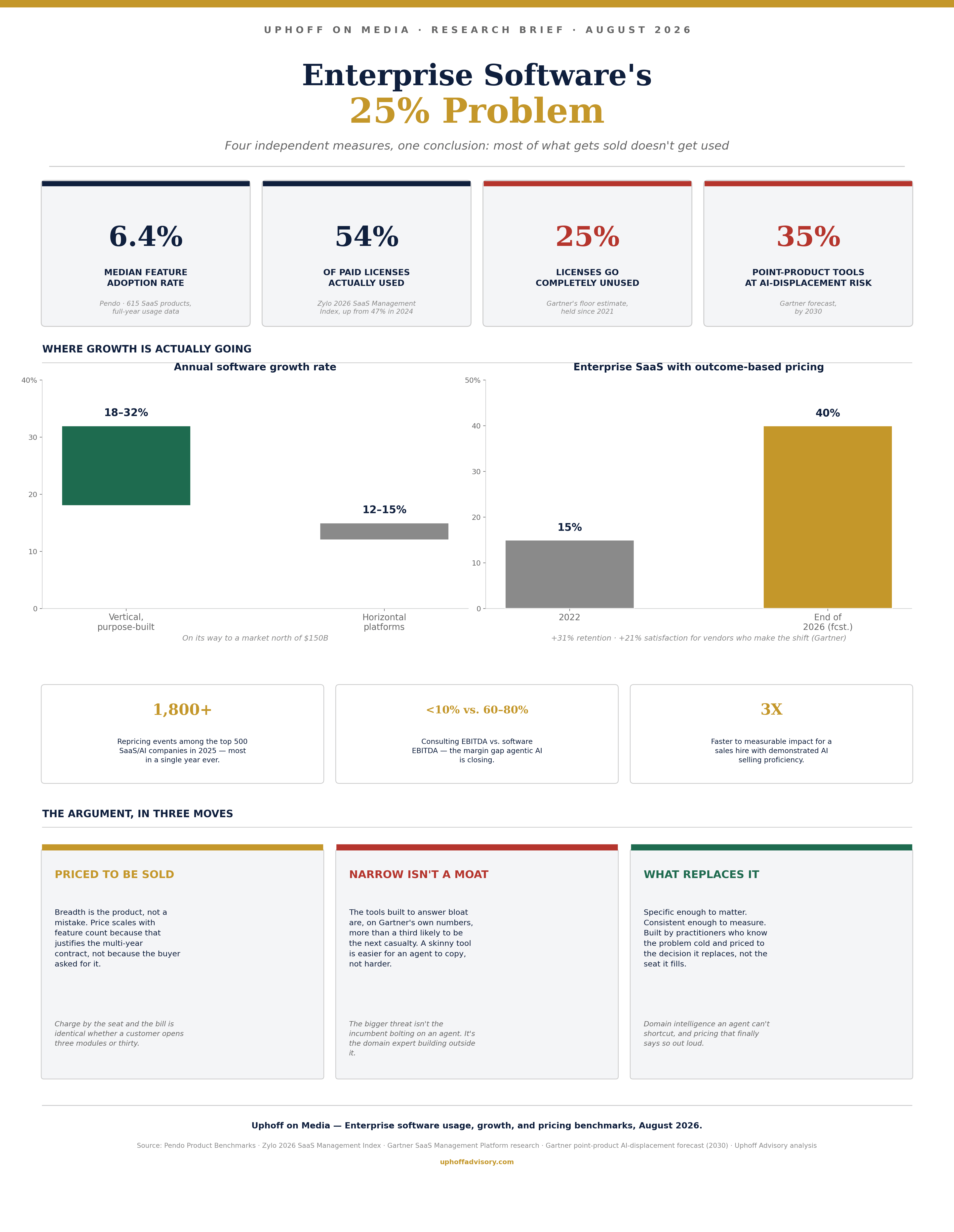
Pendo ran a full year of usage data across 615 SaaS products and published the number that should embarrass the industry: a median feature adoption rate of 6.4 percent.
For every hundred features a team ships, roughly six of them account for 80 percent of what customers actually do with the product.
Zylo’s 2026 SaaS Management Index, built from live telemetry rather than a survey, found the average company uses just 54 percent of the licenses it has already paid for. Different measurements, different years, same conclusion: most of what gets sold doesn’t get used.
Gartner put a floor under this years ago: up to 25 percent of enterprise SaaS licenses go completely unused, not underused, untouched. Call that the 25 percent problem, the most conservative number in the room. Zylo’s more current data says the floor was optimistic.
Ask a CHRO how much of the HRIS they’re running they’ve actually touched this quarter. Watch the pause before the honest number comes out. That pause isn’t a training gap or a change-management failure. It’s the business model working exactly as designed.
Usage is the number nobody wants printed on the invoice. It would say more about what you’re actually getting than the entire feature list combined.
Software wasn’t built to be used. It was built to be sold.
Nobody sets out to build bloat. It evolves, one deal at a time. A platform’s price scales with feature count because that is what justifies a multi-year contract and a land-and-expand sales motion. The roadmap gets built for the next logo, not the last one. Breadth is not a mistake the vendor made. Breadth is the product.
As I argued in “Enterprise Software’s Publisher Moment”, that breadth is what gave software the best margins in the history of business: produce once, sell the identical version thousands of times.
The same standardization that made those margins possible is exactly why the product in your hands was never built for your job. It was built to be sold to everyone’s job at once, and you’re paying full freight for the parts that were built for somebody else’s.
That gap between what you bought and what you use is not new. What is new is that buyers are done tolerating it, and the correction is already showing up in the numbers.
The correction is already priced in
Vertical, purpose-built software is growing two to three times faster than the horizontal platforms it is chipping away at. An 18 to 32 percent annual clip against 12 to 15 percent. On its way to a market north of $150 billion. Pricing is moving with it: Gartner expects 40 percent of enterprise SaaS to carry an outcome-based pricing component by the end of 2026, up from 15 percent in 2022. Vendors making that shift are seeing 31 percent higher retention and 21 percent higher satisfaction rates. In 2025 alone, the 500 largest SaaS companies repriced more than 1,800 times. The most repricing activity in a single year since SaaS subscriptions were launched.
Everyone can see the trend. Buyers are tired of paying for features and seats nobody uses. Vendors are tired of selling seats nobody renews for the right reason. The unbundling of the bloated platform into smaller, sharper tools is not a prediction. It is underway.
Here is where most of the commentary stops, satisfied it has spotted the trend. It has not spotted the trap sitting inside it.
Narrow isn’t a moat
Gartner’s own forecast should give the point-solution crowd pause: 35 percent of point-product SaaS tools are expected to be displaced by AI agents by 2030.
Not the bloated platforms. The narrow ones. The tools that were supposed to be the answer to bloat are, according to Gartner’s own numbers, more than a third likely to be the next casualty, not the correction.
That should not surprise anyone who has actually watched an agent work. A skinny tool wrapped around a form and some workflow logic is not harder for an agent to reproduce than a bloated platform. It is easier. There is less of it to copy.
Small was never the moat. Small was the disguise a certain kind of shallow tool got to wear right up until something got good enough to notice there was nothing else underneath it.
Most of this discussion pictures the displacement as an inside job: the incumbent platform bolting an agent onto its own product to defend the seat count it already owns. That is the smaller threat, and the one every enterprise software vendor is currently budgeting for. The larger one is not coming from software companies at all. It is coming from the domain expert who has spent a career inside the problem the point solution was trying to automate, adding a real intelligence layer on top of it, and shipping the judgment directly instead of selling it by the hour or the seat. I wrote about the shape of that business in “The Vertical Intelligence Company” . The same logic applies here, one layer down the stack.
Usage is the tell
Here is the through-line: usage is what tells you where value actually sits, and most enterprise software is priced so you never have to look at it. Charge by the seat and the bill is identical whether a customer opens three modules or thirty. Charge by usage and the invoice starts asking a question the vendor would rather avoid: why are you still paying full price for the parts you never touch?
That is also a sharper test for what survives the unbundling than simply asking whether a tool is narrow. A tool earns the right to be priced on value only if it gets used the same way, against the same kind of decision, often enough to prove what that value actually is. A tool built for a single urgent moment cannot do that. There is no repeat pattern to measure. A tool spread thin across a dozen loosely related tasks cannot either. The signal gets lost in the spread. What survives is built for a specific problem that keeps recurring, solved with real domain intelligence instead of a generic workflow engine wearing a narrower skin. Specific enough to matter. Consistent enough to measure. Intelligent enough to be worth measuring in the first place.
What replaces it
The tools that will gain adoption are not the ones that got smaller. They are the ones built for a specific, consistent problem, carrying judgment that cannot be scraped off a website or inferred from a form.
The Uphoff Advisory suite serves as a realtime case study here, not a hypothetical. Three tools, currently in testing: the Uphoff Value Index™, the Sales Talent Matrix™, the Marketing Talent Matrix™. Each one structures a single decision. Not a dashboard. How do I make ongoing decisions that drive value creation? How do I assess, hire, coach and manage sales and marketing talent? That’s the sliver Pendo’s data says is actually doing the work, isolated on purpose.
What makes it unique is what an agent cannot shortcut: 35 years spent hiring, coaching, and managing sales and marketing talent through five CEO roles, multiple transformations, acquisitions and several exits. That judgment gets tested against the Friends of Tony expert panel: CMOs, CROs, recruiters, VPs of HR, and investors who provide expert input on features and usage. That group earned its keep recently. It flagged that a sales rep’s practical use of AI in selling had become a first-tier signal, not a later-stage nice-to-have. A hire who shows demonstrated AI selling proficiency reaches impact 3X faster than a hire who doesn’t. The attributes for sales talent changed on the spot.
Pricing has to match what the tool actually does
Usage told you where the value sits. Pricing on anything other than that value, seats, logins, monthly access, is pricing that is deliberately looking away from the answer.
The old services trap was one expert, one engagement, finite hours: the reason consulting firms average under 10 percent EBITDA while software runs 60% to 80%. As I wrote in “Solo Scale”, agentic AI is what breaks that ratio. It is the reason a domain expert can now build and ship the tool directly instead of writing the same advice into a deck for the hundredth client. Building the tool got cheap. The judgment inside it did not, and pricing needs to reflect this shift.
I did not hire a product team to build the Uphoff Advisory suite. I built it the way I would have written a diagnostic for one client, except this time the diagnostic became software instead of a memo or a presentation. Each tool encodes a single piece of judgment I would otherwise deliver face to face: what a business is actually worth building toward, whether a rep is worth the offer, whether a marketer is ready for the next level.
Three to four years ago, before agentic AI, that same build would have needed a product manager, two or three engineers, and a designer, six to nine months of development, and a budget somewhere between $250,000 and $500,000 before the first version ever touched a real client. That team and that budget were never available to a one-person advisory practice. The judgment stayed locked in the practitioner’s head, delivered one meeting at a time.
Agentic AI is what closed that gap. The actual build history: I am not an engineer. I described the decision I wanted structured, in the same plain language I would use in the room, and rebuilt it against real client work until the logic held. If I can do that, the CFO who has priced forty deals can do it. So can the recruiter who has placed two hundred VPs. That is not false modesty. It is the honest version of the threat every enterprise software company should be watching: the barrier that used to protect them from domain experts just came down, and most domain experts have not noticed yet.
Which is also why the tools aren’t sold by the seat. They’re not sold at all, not separately. They come bundled into the advisory engagement, priced the way the decision itself is priced, because a tool that structures one decision is part of the work of making that decision, not a rentable dashboard sitting next to it. That is the pricing model this whole genre needs: priced to the decision it replaces, what a hiring mistake costs, what a mispriced exit costs, not what a monthly per-user line item can be padded to justify. Most of what is currently rushing into the unbundling gap has not figured that out yet. It is still charging platform prices for point-solution software, hoping nobody notices it kept the old pricing logic after it dropped the old feature list.
Every domain has one of these practitioners
Here is the bigger bet. Every domain has its own version of a practitioner sitting on decades of judgment nobody else has: the controller who has closed the books at a dozen portfolio companies, the general counsel who has negotiated two hundred vendor contracts, the operator who has run a dozen supply chain turnarounds. Until recently, that judgment had exactly one distribution channel: their own calendar, one client at a time, capped by the hours in a week.
Agentic AI breaks that cap. Not by replacing the practitioner’s judgment. By letting the practitioner ship it as software, cheaply enough to be a real product instead of a slide deck. That is Solo Scale’s mechanism, carried one step further. Solo operators will not just run bigger service businesses. They will build specific-use software out of the judgment those businesses were already selling by the hour, and use it to scale the service itself.
Watch for this pattern well outside B2B talent and valuation. What eats into enterprise software from here will not be smaller platforms. It will be specific-use tools, informed by real domain intelligence, solving the same specific problem often enough to prove it in usage, built by practitioners who already know that problem cold and priced like the value they produce, not the seat they fill.
These tools structure the thinking. The decision is still yours. That was always the point. It is about to become a movement.
The views expressed in Uphoff on Media are entirely my own. They don’t represent the opinions of any company I’ve led, any board I’ve sat on, or any investor who’s had the pleasure of debating strategy with me over the years. If something I write here sounds brilliant, I’ll take full credit. If it turns out to be wrong, I was clearly misquoted by myself.
“Uphoff on Media” is published by Tony Uphoff, Founder and Managing Partner of Uphoff Advisory, LLC: a strategic advisory practice for founders, CEOs, and investors in B2B information, marketing, and technology. The businesses that drive business.