



Nine months after launching Uphoff Advisory and Uphoff on Media, I had a discovery problem. Seventy-four posts, a growing framework library and a suite of client tools, and not enough of it was being found in search or recommended by AI.
Here’s the admission: I’d spent 20-plus years running companies with teams who did this work. I knew what good looked like. I didn’t know how to do it.
So I handed it to my agents. This was my own back office, not client work. They built or rebuilt 27 framework pages, re-rendered about 30 charts and audited all 74 posts for broken links.
Working alone, a skilled person would need about four weeks to do that. I spent nine hours.
It’s tempting to say AI did the work. It didn’t, and a lot of operators are building their plans on that mistake. The agent didn’t take me out of the work. It moved me from production to judgment. The leverage came from that shift, not from the automation.
Solo Scale was a thesis. The data is starting to come in
In July I argued in Solo Scale that agentic AI breaks the constraint that has kept every services business at services margins: one expert, finite hours, revenue that scales with headcount. I wrote that the operator “sets strategy, reviews output, exercises judgment” while agents handle the production.
That was an argument. This is a test of it against my own business, with the limits stated up front. It’s one project and one operator. The counts of pages, posts, links and URLs are exact. The hours are estimates, not time sheets, and nine is the high end of mine. Read them as an order of magnitude, not an exact count. The four-week figure is a line-item estimate, not a guess: writing 27 pages is the biggest piece at 40 to 68 hours, followed by building them in WordPress and re-rendering the charts.
Four weeks against nine hours is roughly 18 to 1. At the low end of the estimate, 125 hours, it’s still 14 to 1.
Where my hours actually went
The division of labor was clean on paper.
Decisions: I made every publish call, nine rounds of three pages, plus the names, the standards and which version of a chart was accurate. The agent proposed each one with a recommendation and the trade-off.
Framework pages: For the library on my website, the agent wrote the pages describing the Frameworks I created, including How-to steps, FAQs, SEO fields and alt text. It built every page in WordPress and verified each one live. I reviewed.
Charts: The agent re-rendered and rebuilt about 30 and checked the stats against sources. I uploaded them.
Substack: The agent wrote every link line and alt text and verified every post afterward. I made the edits in 22 posts and fixed 6 links.
Search: The agent got all 27 pages to green in Yoast, audited 74 posts and checked 31 URLs. I submitted the sitemap.
Records: The agent kept the upload workbook, link map, tracker and status doc current. I didn’t touch them.
Look at what I actually did on that list. About half of my nine hours went to Substack edits, and another hour or two to uploading images. That’s production, not judgment. I was doing it by hand because Substack blocks the agent from that work and getting files into WordPress’s media library stayed manual.
So the division isn’t clean yet. Only two to four of my nine hours went to real judgment calls. The rest went to manual work the tools wouldn’t let the agent touch. That’s plumbing, and plumbing gets fixed. None of it needs me.
The checking was worth as much as the speed
The number that will get quoted is the hours. What the checking found mattered just as much.
Four published facts were wrong. All four were mine, and they’d been live.
A stat credited to the wrong firm: “94% of B2B buyers use LLMs” was attributed to Forrester and CMI on two charts. It comes from the 6sense 2025 Buyer Experience Report.
A chart that contradicted its own post: One chart said mid-market B2B was “finally off premise” in 2018. The post it ran with said the opposite.
A chart that didn’t match its text: The post described seven questions. The chart showed six.
A count that didn’t add up: One framework page said “four squares” and listed five.
None of these were catastrophic. Each one is exactly the kind of error a careful reader finds, and the readers of this publication are careful readers. I would not have audited 74 posts by hand. Nobody running a business has the time.
The agent found the errors. It didn’t decide what to do about them. The chart that contradicted its post needed a new label that was true in both places. The seven-question index needed its scoring range rebuilt. Those were calls, and they were mine. Verification moved to the agent. Deciding what’s true stayed with me.
Judgment becomes the lever, not the cost.
The build was fast, not frictionless, and the friction is the most useful part of the story.
The one hour I’d take back came from a call I made late. The Uphoff Value Index went from “Value” to “Valuation” and back again inside an hour. Each switch meant a chart re-render, a page retitle, a URL change and a redirect: four pieces of work, each done twice. That waste was mine, not the agent’s.
Agents multiply whatever direction you give them. Make the call early and they multiply the work. Make it late and they multiply the rework.
Not every mistake was a decision, and not all of them were the agent’s. One round of uploads landed on the development site instead of the live one. A stray bulk upload pulled in 29 files. All 18 rebuilt pages went to the trash once and came back with Undo. Every one of those was fixed in minutes, because the records were current and the standards were already written down.
That’s the operating lesson. In every transformation I was brought in to lead, execution was where things broke, and the worst breaks traced back to decisions that came after the work had started. Agents raise the stakes. They execute so fast that a clear call made up front pays off almost immediately, and a late one throws away work that’s already done. The leverage is in the calls you make before the work starts.
An Output Multiple isn’t a Scale Multiple yet
Last week I wrote about the difference between an Output Multiple, how much more a person produces on one workflow, and a Scale Multiple, how much more revenue each person brings in. This build is an Output Multiple. A large one. It is not yet a Scale Multiple, and I’d be overselling it to call it one.
For anyone new to the terms: Solo Scale is one expert running agents, from $250,000 to $5 million in revenue at 40% or better EBITDA. Team Scale is the next rung, a small senior team doing the same at $400,000 or more of revenue per employee and 25% or better EBITDA, from $2 million to $30 million. Both are defined by revenue per person, not headcount. For context, the median private SaaS company does about $175,000 of ARR per employee, and WPP, the largest agency holding company, about $130,000 per person. This build is evidence on the input side of that math, not the revenue side yet.
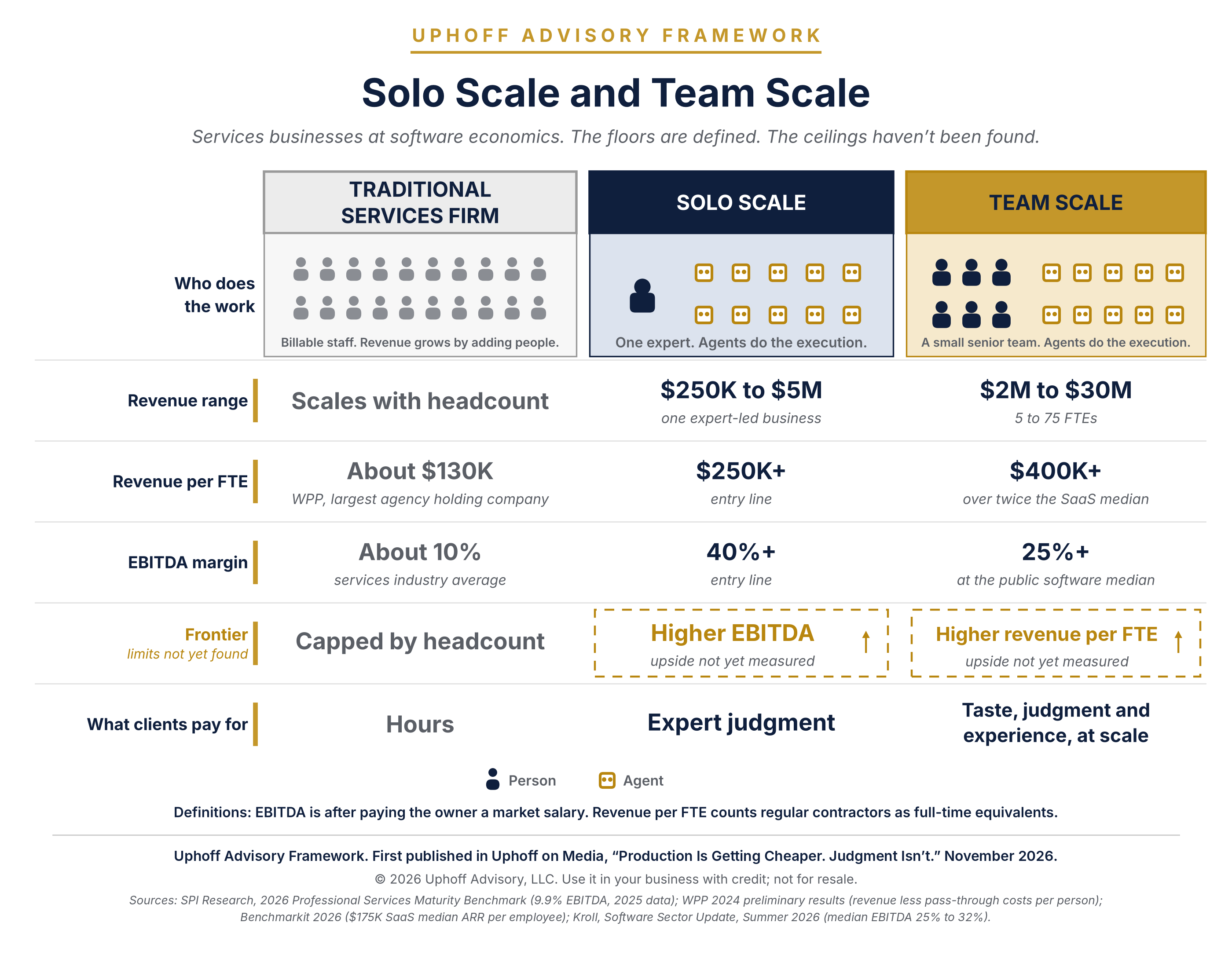
Then there’s the cost. The agents ran on tools I already pay for. Four weeks of the same work, hired out at typical freelance SEO rates of $75 to $100 an hour according to an Ahrefs survey, would have cost roughly $12,000 to $16,000. One thing isn’t in that comparison: my web developer made a configuration change at no charge that let the pages hold real content. It doesn’t change the order of magnitude, but it belongs in the record.
The more important point is what the comparison actually is. I was never going to hire a writer, a designer and a web producer to rebuild 27 pages of my own IP. Without the agent, the library stays half built. That’s the real Solo Scale effect. The work isn’t just cheaper. Work that would never have been funded now exists.
Whether it turns into a Scale Multiple depends on what the operator does with the hours the agent gave back. While the agent was building the library, I brought on a new advisory client. One additional client isn’t a Scale Multiple, but it’s exactly where those hours are supposed to go. If they go into more client work and better client work, the margin shows up. If they go into more production, it doesn’t.
I work more hours, not fewer
Here’s what I didn’t expect. You’d think a Solo Scale business means working fewer hours. I work more. What changed is where they go.
When I launched the firm, a real share of my week went to production: formatting, uploading, fixing links, keeping records. Most of that now sits with the agents. Those hours moved to the work clients actually hire me for: research, analysis, planning and strategy.
It shows up in the engagements. Less of my time goes to the production that comes with project work, so more of it goes to the connected issues that decide whether a business grows: positioning, packaging and pricing, the roles a team needs and who fills them, channel strategy, and coaching the leaders who have to carry it all. None of that is production. All of it sits in the Keep It box.
That’s what a services business with software margins looks like up close. It’s a judgment business with a production engine underneath it. The engine does more every quarter. The judgment is what clients hire me for.
Sort the work before you hand it off
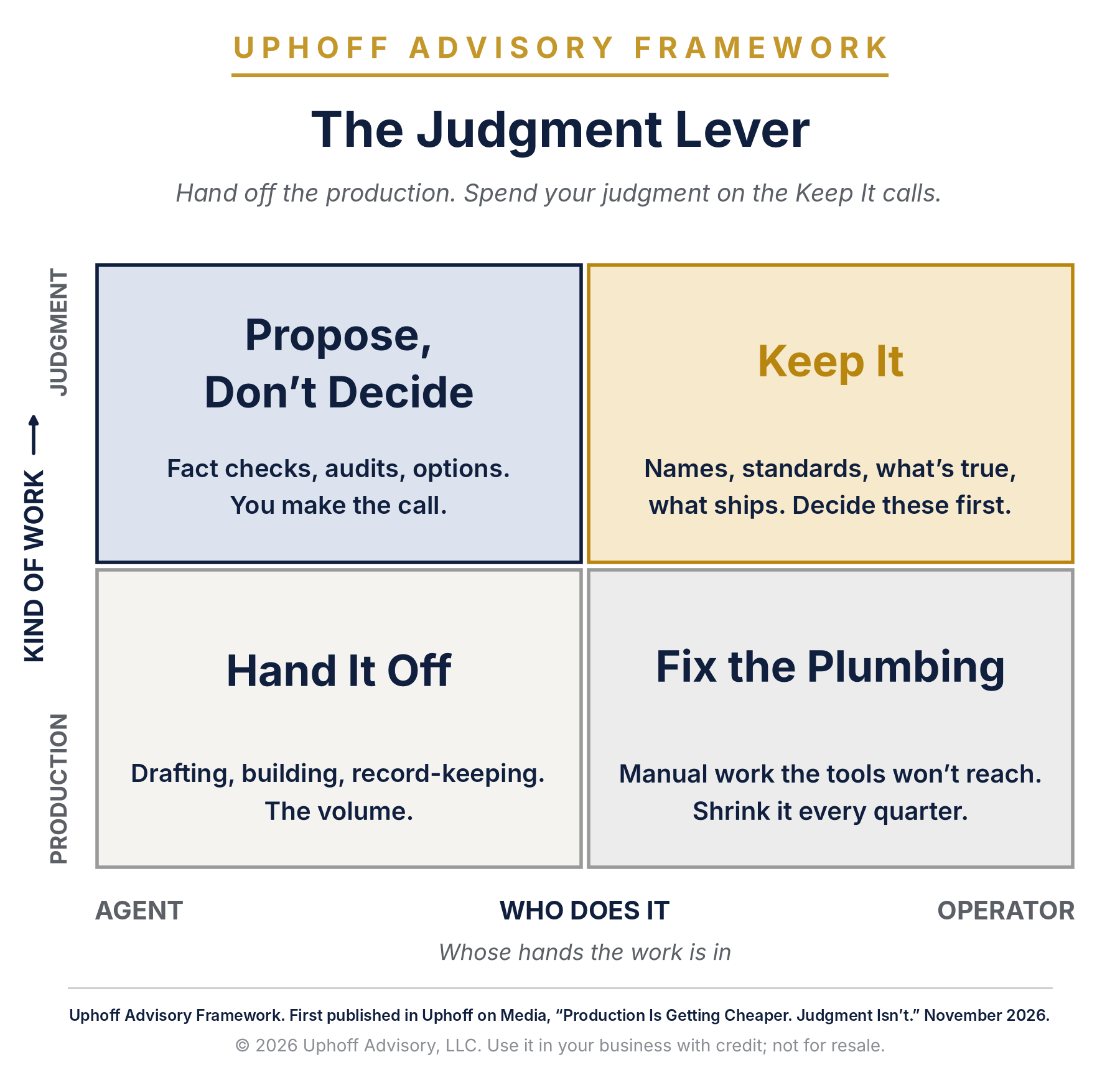
Here is an Uphoff Advisory Framework you can download and use in your business. Put any project on it before the agent starts, and log your hours against it after.
The Judgment Lever sorts work along two lines: who executes it, the agent or the operator, and what kind of work it is, production or judgment.
Hand it off: (agent, production). Drafting, building, rendering, record-keeping. The volume.
Propose, don’t decide: (agent, judgment). Fact checks, audits, options with a recommendation and a trade-off. The agent brings the call. It doesn’t make it.
Keep it: (operator, judgment). Names, standards, what’s true, what ships. Make these first.
Fix the plumbing: (operator, production). Work you still do by hand because the tools won’t connect. This quadrant should shrink every quarter. If it doesn’t, start there.
View the full Uphoff Advisory Framework library →
What to do with it this quarter
If you’re building, running, funding or starting a services business, run one project through The Judgment Lever and keep score.
Make the “keep it” calls before production starts: names, sources, standards, what done looks like. Track where your own hours land. If most of them sit in “fix the plumbing,” you don’t have a judgment problem. You have an integration problem, and it’s the cheapest one you’ll ever solve. If you fund services businesses, ask the operators you back the same question. How much of their leaders’ time still goes to production?
The agent will take more of the work every quarter. It won’t make the calls, and it can’t make them early on your behalf. Hand it the production. Keep the judgment calls, and make them first.
Keep going: Loop Engineering: The Bridge to Workflow Transformation and The Teammate That Never Logs Off
The views expressed in Uphoff on Media are entirely my own. They don’t represent the opinions of any company I’ve led, any board I’ve sat on, or any investor who’s had the pleasure of debating strategy with me over the years. If something I write here sounds brilliant, I’ll take full credit. If it turns out to be wrong, I was clearly misquoted by myself.
Uphoff on Media is published by Tony Uphoff, Founder and Managing Partner of Uphoff Advisory: a strategic advisory practice for founders, CEOs, and investors in B2B information, marketing, and technology.
Production to judgment is exactly how it's gone in our editing. The tools find and cut much faster now, and the hours left over go into deciding what's worth keeping.