



Go to Intercom’s pricing page and you will find the same company selling customer service two different ways. Human agents are priced the old way: $29 to $132 per seat, per month. Its AI agent, Fin, costs $0.99 per outcome, with no seats required.
That page is a small picture of a large shift. When software does the work, the seat stops measuring the value, and the price has to find a new unit. The number on the page is the easy part. The unit underneath it is where the business gets decided.
Here is the pattern I see across B2B information, marketing and technology companies right now. The cost of building a product is falling, and the cost of copying one is falling faster. In the businesses I work with, a feature that took a competitor a year to copy now takes about a quarter. When the product gets cheap to make and easy to compare, the value doesn’t disappear. It moves into three decisions no machine can make for you: what you stand for, what you bundle and what you charge.
Positioning. Packaging. Pricing. Positioning. Packaging. Pricing. I’ve used those three to diagnose businesses for years, the ones I’ve led and the ones I advise.
The buying committee has a new member
Every B2B company now sells to a buying committee and to the machine that committee sends ahead.
The data on the second buyer is no longer thin. In a Gartner survey of 646 B2B buyers, published in March, 67% said they prefer a buying experience with no sales rep, and 45% said they used AI during a recent purchase. 6sense’s 2025 Buyer Experience Report, drawn from more than 4,000 buyers, found that 94% used large language models during the buying process, and that the vendor a buyer favors before talking to anyone still wins 80% of the time.
Read those two findings together. The shortlist is being built before your team knows a deal exists, and the vendor that leads the shortlist usually wins. The agent doing the early research applies a pass or fail test to whatever it can read about you. The committee that follows applies a different test: can I defend this choice to my CFO and my board?
Positioning, packaging and pricing are how you pass both tests. They are also where most B2B companies are weakest, and for years that weakness was affordable. Sales and marketing did the alignment work live, at the point of contact. A good rep translated a vague homepage into the buyer’s problem, built a bundle on the call and found a price the buyer could take to finance. The three decisions didn’t have to line up on paper, because a person lined them up in the room.
An agent doesn’t wait for that conversation. It reads what you publish, compares you with every alternative, and passes or fails you before anyone on your team knows a deal exists. Miss on any of the three and you lose the deal before it starts, without ever learning it was there. That is why the cost of getting these decisions wrong has gone up. The sales team is no longer in the room when the shortlist gets made.
Putting the offer in front of the room
So I’ve been building that room. I call it Buying Committee Modeling, and it is now an Uphoff Advisory solution for clients.
Here is how it works. A typical model seats seven or eight roles, from the executive sponsor to finance to the team that will use the product, each an AI persona built around how that role weighs a purchase. A separate agent stands in for the buyer’s AI, running the same searches it would use to build a shortlist. Then the offer goes in front of all of them, the positioning, the package and the price, as a buyer would find them, in two to four different buying situations.
Each seat answers on its own, three times in each situation, so a single offer produces dozens to more than a hundred independent responses. Every answer follows the same format: how likely the seat is to take a meeting and to shortlist the offer, a stance from Champion to Blocker, the objection that would kill the deal and what would turn it into a yes. Those answers are tabulated as medians and ranges, never as one opinion. Each committee then deliberates to a verdict: advance, advance with conditions, park or decline. Finally, a blind reviewer that never sees the committee’s answers scores the offer on seven dimensions, from value clarity to price-to-value to how easily an agent can read it, and names the one to fix first.
What comes back is the conversation your sales team never gets to hear: the objections, the questions finance will ask, and whether the agent finds you at all. The modeling doesn’t predict who will buy. It guides the three decisions, showing where your positioning, packaging and pricing are working and where they aren’t, before a real buyer sees them. It also validates your ideal customer profile: put the same offer in front of different committees and you see which buyers it actually fits. And you can run it again every time you change one of the three decisions.
I started with my own firm, and I now use it with clients to test positioning, packaging and pricing before they go to market. I’m not the first to build something like this, but very few companies have seen their offer the way this room sees it. I’ll share what the modeling is showing in future posts.
Positioning has to survive being read literally
An agent reads what you publish, not what your best rep says on a call. “Solutions that accelerate growth” passes no test, because it describes every company in the category. Positioning in the agentic era has to name the buyer, the problem and the result in words specific enough that a machine can match them to a request and a human can repeat them in a meeting.
That is a higher bar than most homepages clear. It is also the first decision, because the other two follow from it. You can’t package around a promise you haven’t made, and you can’t price a result you haven’t claimed.
When I was brought in to transform Thomasnet, the work started here. The company was known as an industrial directory. The value buyers actually got was sourcing: finding a qualified supplier faster, with data they could trust. Repositioning around that job, and rebuilding the business as a sourcing and data platform, is what made the rest of the transformation possible.
Packaging is where most of the money hides
In nearly every company I’ve been brought in to turn around or transform, I found the same thing: products sold à la carte to customers who wanted an integrated solution that worked like a recipe. The catalog described what the company made. It didn’t describe what the customer was trying to get done.
At Thomasnet, moving from à la carte to solution pricing raised the average sale by 40%. At Pipeline360, we built a Branded Demand solution that combined programmatic display with data-driven demand generation at one price. Order size and retention went up, and campaign performance improved by more than 35% on average. The products didn’t change much. The package did.
Agents raise the stakes on this. A buyer agent comparing vendors breaks an à la carte catalog into line items and prices each one against the market, which is how a product gets turned into a commodity. A program built around an outcome is much harder to pull apart.
For digital media and marketing products, the test I use is simple: an ad, sponsorship or lead-generation product earns its place on the rate card when it sells at least half of its available inventory. Below that, fold it into a program or retire it. Most media companies I review carry several products that fail that test and are still being sold, produced, billed and reported every month.
Pricing is breaking at the unit, not the number
Seat-based pricing assumes a human does the work and the software helps. When an agent does the work, the number of seats shrinks while the value delivered goes up, and a price built on seats falls exactly when the product is getting better. That is the reason a company like Intercom now prices the same work two ways on one page.
The fix is a new unit, chosen from what the buyer counts as value: an outcome, a resolved case, a qualified lead, a decision supported. Picking that unit is a positioning decision as much as a pricing one, which is why the three can’t be worked in isolation.
The discipline underneath doesn’t change. As I argued in Thanks for the Lecture on Price, a price is the last step of a process that starts with the market and the financials and ends with the price-to-value case a buyer can defend. What has changed is how quickly a weak case gets exposed.
Why it has never been harder
There are four reasons, and they compound.
Two buyers apply two different tests. The agent wants literal, comparable facts. The committee wants a story it can defend. Positioning that is precise enough for the first and compelling enough for the second takes more work than either one alone.
The three decisions are now tied together. Change the pricing unit to outcomes and the package has to change to deliver them. Promise an outcome in your positioning and you have to be able to measure it, or the price falls apart in the first renewal.
Copying is faster. A competitor can match your package in a quarter and undercut your price in a week. The advantage now goes to whoever revisits the three decisions most often.
Outcome pricing needs data most companies don’t have. You can’t charge per result if you have never measured results. For many B2B companies, the first year of outcome pricing is really the first year of measuring what they deliver.
Work them in order
Here is an Uphoff Advisory Framework you can download and use in your business. Take one offer you sell today and run it through the three questions in order. The order matters: never package before you’ve positioned, and never price before you’ve packaged.
1. Positioning: Who do we serve, what problems do we own, and what result do we deliver?
2. Packaging: How does this fit with the rest of what we sell, and with what the customer already uses, to deliver outcomes they can measure?
3. Pricing: What does the buyer count as value, and do our unit economics hold at that price?
These three questions are where every Uphoff Advisory Growth Plan starts, and Buying Committee Modeling is how I now test the answers against both buyers.
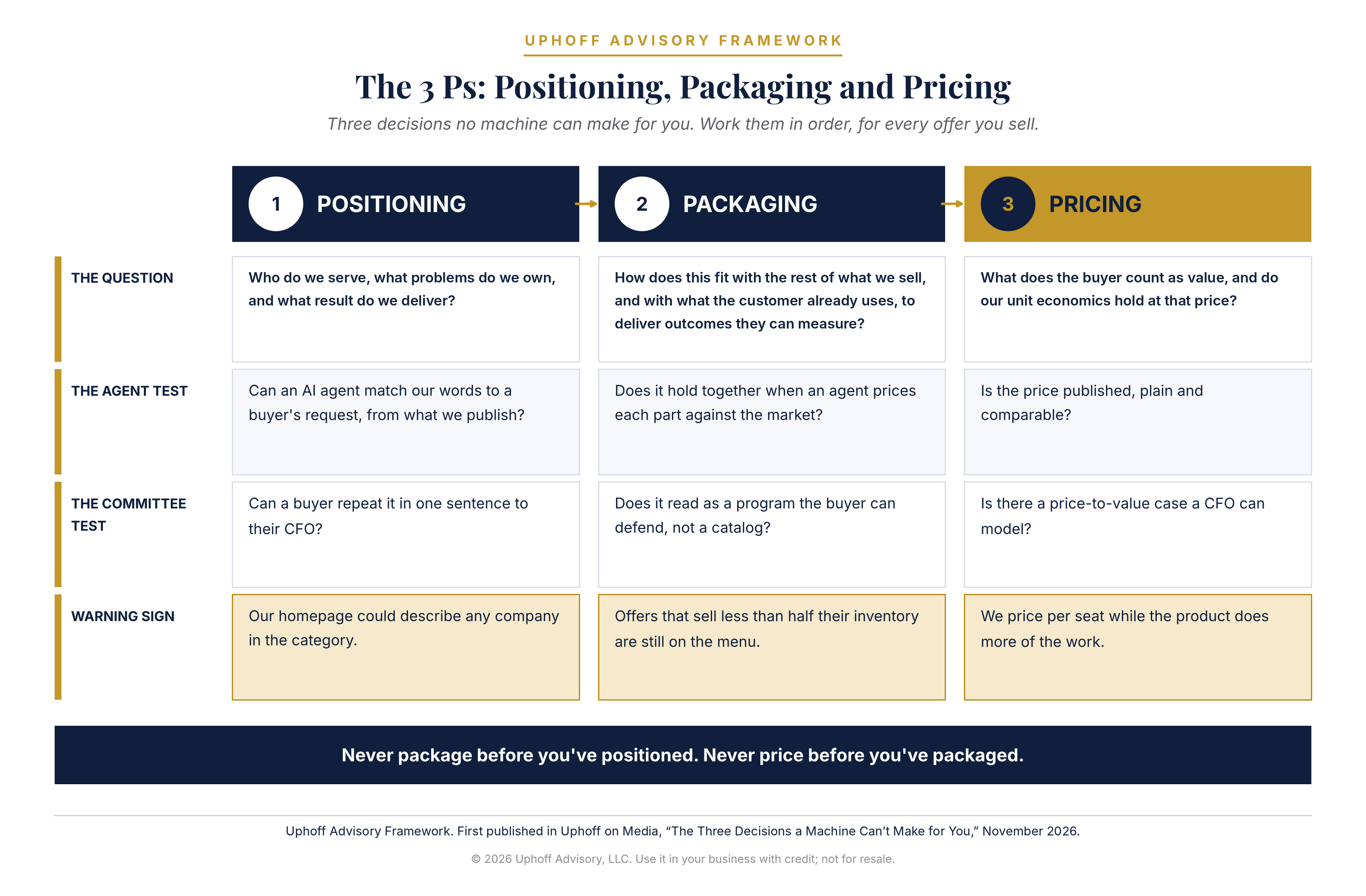
The 3 Ps of Positioning, Packaging and Pricing
Download The 3 Ps: Positioning, Packaging and Pricing →
View the full Uphoff Advisory Framework library →
The decisions you leave unmade get made for you
Your competitors will be able to copy most of what you build by next spring. What they can’t copy is a clear answer to who you serve, what you sell them and what it is worth. If you don’t make those three decisions, the market will make them for you, and a buyer’s agent will report the result to a committee you never met.
Keep going: The Buyer Left the Building and Enterprise Software is at a Crossroads
The views expressed in Uphoff on Media are entirely my own. They don’t represent the opinions of any company I’ve led, any board I’ve sat on, or any investor who’s had the pleasure of debating strategy with me over the years. If something I write here sounds brilliant, I’ll take full credit. If it turns out to be wrong, I was clearly misquoted by myself.
“Uphoff on Media” is published by Tony Uphoff, Founder and Managing Partner of Uphoff Advisory: a strategic advisory practice for founders, CEOs, and investors in B2B information, marketing, and technology.
"Can I defend this choice to my CFO?" is the test AI never takes. The agent builds the shortlist. Nobody's agent gets called into the CFO's office.
On the machine comparing you to every alternative: the trap I see with AI is owners using it to make more of the same content faster. A better use: paste your homepage next to three competitors and ask AI where you sound the same. That list is usually longer than people expect, and it tells you exactly what to fix.