

Motion Is Not Transformation
There are two ways to be wrong about a technology wave. Right now, the less obvious one is doing more damage than the one everyone worries about


There are two ways to be wrong about a technology wave.
The first is obvious. You move too slow. You dismiss the shift, protect legacy revenue, and by the time you look up, a competitor with worse products and better timing owns your category.
The second failure mode gets less attention, and right now it’s doing more damage. You see the wave coming. You paddle toward it. You catch it, and then you misread what’s required to ride it in. You mistake motion for transformation. You confuse deployment for strategy. You restructure for a world that isn’t here yet.
I’ve lived both. And watching B2B information, marketing, and technology leaders respond to agentic AI right now, I’d argue the second failure mode is winning.
I’ve seen this before
In the mid-1990s, I was running a large B2B media business when the internet arrived. We did what you were supposed to do. We moved to digital early: websites, email newsletters, reporters shifting from monthly deadlines to daily posting. Against everyone we were used to competing with, we looked like the future.
Here’s what I learned in hindsight: we were early on the technology and late on the business model transformation it required.
We treated digital as a new delivery channel for the content and advertising model we already had. We never asked the harder question: does digital change the fundamental value we create, and for whom? We hired web editors and kept print-era revenue logic. We launched online properties and priced digital ads against print CPMs. We moved, then stopped moving before the transformation was actually complete.
The companies that got through that era best weren’t the ones who moved first. They were the ones who understood that the first wave of digital (getting content online) didn't create bigger profit pools. Wolters Kluwer CEO Nancy McKinstry put it plainly, years later, on an HBR podcast: "The shift from print to digital didn't create any bigger profit pools. In fact, I would argue that the profit pools shrunk”. The winners understood what wave two required: a different business model, not a new channel.
That lesson applies directly to what’s happening right now.
This isn’t the mandate-or-wait debate
A few weeks ago I argued in “How Do We Move?” that agentic AI’s near-zero trial cost makes waiting its own mistake. Structured experimentation, one workflow, run in parallel, measured honestly, should start now. I still believe that.
This is a different question: direction, not speed. The leaders making the second mistake right now aren't standing still. They’re moving fast, in ways that don’t reverse: cutting headcount, ripping out tech stacks, risking revenue that still works. They're doing it before the market has confirmed where this wave is actually going.
The pattern is repeating
Agentic AI is a new operating environment. It will eventually restructure how buyers buy, sellers sell, content gets made and distributed, and companies get organized. Today it still looks like faster software. That’s the trap.
That word “eventually” is the key.
The gap between what agentic AI will do and what it's actually doing right now inside most B2B organizations is enormous. The hype curve and the adoption curve are not the same line. Leaders making structural, irreversible decisions off the first one are making the second mistake. They're moving. They're just moving in the wrong direction.
What the data actually says
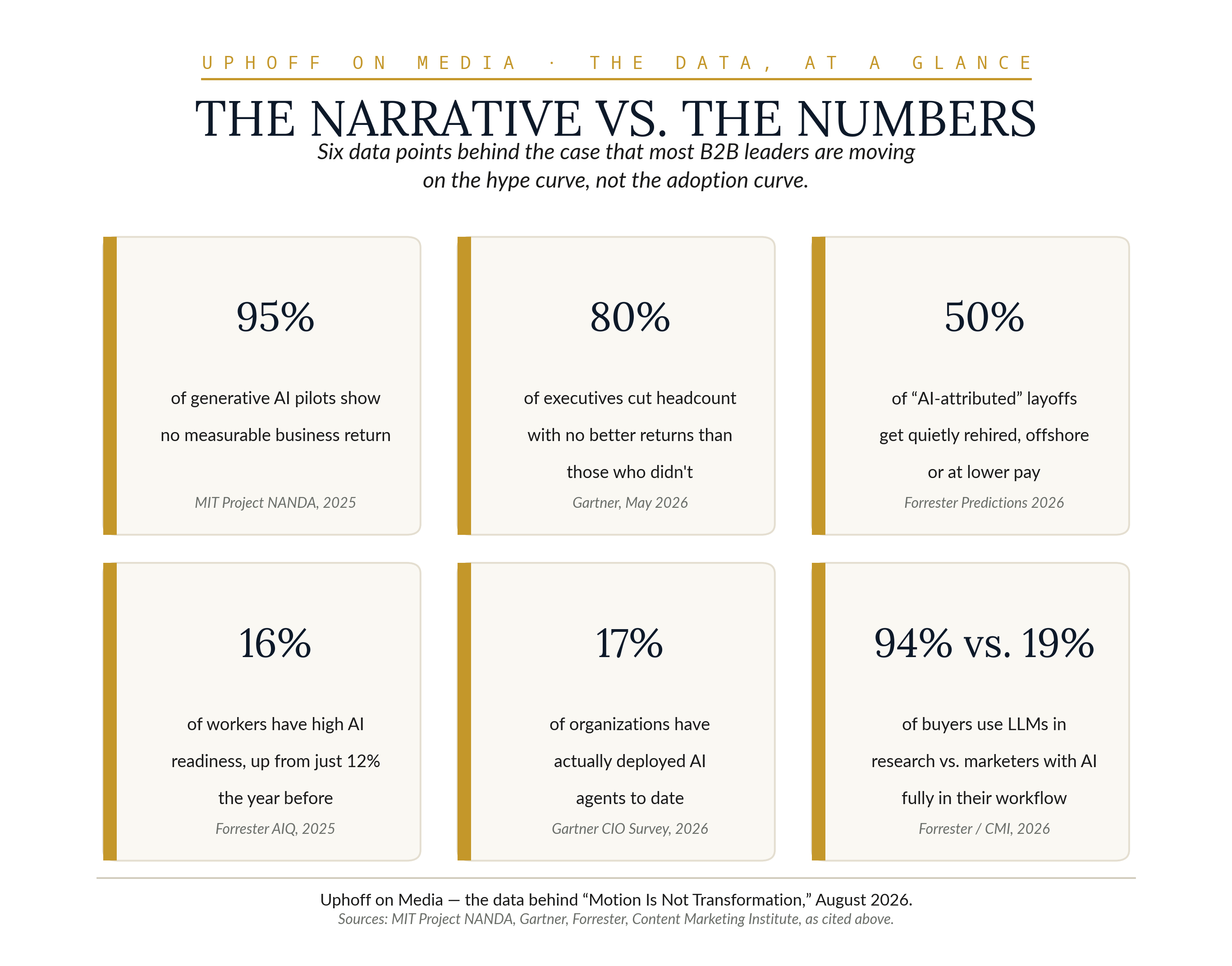
The ROI problem. MIT’s Project NANDA put a hard number on it in the 2025 GenAI Divide report: despite $30 to $40 billion in enterprise investment, 95% of generative AI pilots produced no measurable business return. A Gartner study of 350 global executives, published in May 2026, found that 80% had reduced headcount, and the companies that cut the most showed financial returns nearly identical to the companies that cut the least. Cutting people didn’t buy performance. It bought a smaller company.
The rehire pattern. Forrester’s Predictions 2026 report goes further: half of AI-attributed layoffs will be quietly rehired, offshore or at lower pay, because the capabilities companies bet on aren’t ready. Fifty-five percent of employers already regret the AI layoffs they made. Among the people actually running AI investment decisions, more expect it to increase headcount over the next year (57%) than expect it to shrink headcount (15%). The people closest to the technology are the least convinced by the layoff narrative.
The Klarna story, updated. Klarna is the case study everyone cites. Here’s what actually happened: the company replaced 700 employees with AI, watched service quality drop, and began rehiring in 2025. By mid-2026 it had settled on a hybrid model: AI handles roughly two-thirds of customer inquiries, the remaining third routes to human contractors. CEO Sebastian Siemiatkowski’s new framing: once AI can handle the simplest service interactions, human service becomes close to a premium offering. This may well be the model of the future, but not the path to get there.
The readiness gap. Forrester’s AIQ research found the share of workers with high AI readiness moved from 12% in 2024 to just 16% in 2025, even as 68% of organizations reported generative AI running in production applications. Deploying the tool and building the competency are not the same investment, and most companies are only making one of them. By March 2026, Forrester was reporting that workers had grown reluctant to use the AI tools they’d been given, afraid that visible proficiency would mark them for the next round of cuts. Call that what it actually is: not resistance to the technology, fear of what using it well will cost them.
The adoption gap. Gartner’s 2026 CIO and Technology Executive Survey found only 17% of organizations have deployed AI agents to date. Gartner expects 40% of agentic AI projects to be canceled outright by the end of 2027. The hype and the deployment data are wildly out of synch.
The buyer gap. Buyers, meanwhile, have already moved. Ninety-four percent now use large language models during B2B research, and Forrester’s Buyers’ Journey research found 89% have adopted generative AI as a top source of self-guided information. The Content Marketing Institute’s 2026 research puts a number on the gap that matters: B2B buyers work through roughly 13.4 pieces of content before ever contacting sales, and 67% of the buying journey now happens with no vendor interaction at all. Yet only 19% of B2B marketers say they’ve fully integrated AI into daily workflows, and fewer than four in ten see a real performance lift from what they’ve adopted. Buyer behavior moved first. Marketing execution is still catching up.
It is not uncommon for the narrative and the data to be in conflict in the early stages of a technology wave. Part of leading through disruption is knowing when and how to move.
Three over corrections are already underway
Based on what I’m seeing across B2B media, marketing, and technology, three patterns stand out.
1. Eliminating human judgment before AI judgment is proven. The jobs being cut fastest aren’t the most automatable. They’re the most visible on a cost line: content teams, editorial staff, mid-level marketing managers, customer success. In B2B media specifically, the people being cut often hold the institutional knowledge, client relationships, and editorial voice, precisely the assets that get more valuable in an environment saturated with AI-generated content. The Klarna case study makes the point better than any warning could: human judgment didn’t get eliminated, it got repriced as a premium. Companies cutting that capability now are selling the asset right before the market reprices it upward.
2. Rebuilding the tech stack before the use cases are proven. The martech landscape spent fifteen straight years compounding: every year, more tools than the last. In 2026 that finally stopped. Chiefmartec’s May 2026 count found the landscape had reached 15,505 solutions, up just 0.79% year over year, essentially flat after a decade and a half of expansion. The more instructive number is underneath: 1,488 new tools were added and 1,367 were removed, and new entries dropped 40% from the year before. That’s a correction, not growth: a market working through the hangover of accumulating technology it never fully integrated. The lesson from the print-to-digital era repeats: adding technology is not the same as transforming the business. Leaders ripping out and rebuilding their stacks under agentic AI pressure, before their data, talent, or use cases can support it, are about to relearn that lesson at a worse price.
3. Adding AI features without adding customer value. This one is the easiest to miss, because it looks like progress. In the print-to-digital transition, plenty of publishers ran their print layout through a PDF generator, called it a digital edition, and counted it as transformation. The reader’s experience never actually changed. The equivalent today is B2B software companies bolting a chat panel or a “copilot” badge onto an existing product without integrating it into a real workflow. MIT’s Project NANDA found that narrow, workflow-integrated AI tools succeed roughly twice as often as generalized AI layered on top of an existing product. A separate 2026 survey of 230 B2B software and AI companies found that AI spend mostly comes out of customers’ existing technology budgets, not new ones, and higher still among the SaaS companies adding AI features specifically. Most of what’s shipping isn’t expanding customer value. It’s repackaging the value that was already there. A feature list is not a business model.
Two clocks, not one
Here’s the closest thing I have to a framework for leading through this correctly: disruptive technologies run on two clocks at once, and confusing them is where most leaders get into trouble.
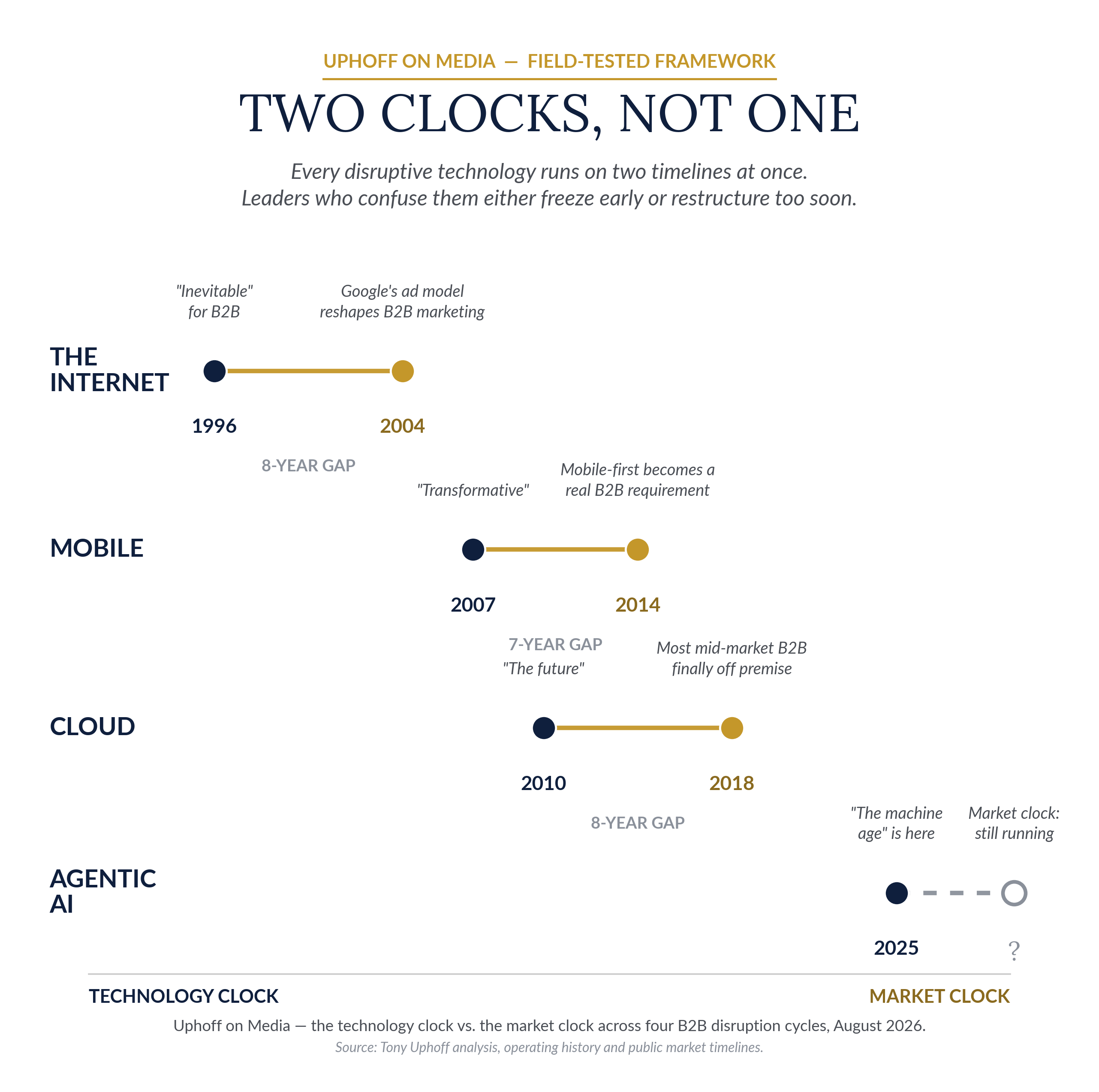
Clock One is the technology clock: the rate at which the capability itself develops. Agentic AI is moving fast on this clock. Models are improving, agent frameworks are maturing, infrastructure is being built. Urgency is appropriate here, and it’s exactly what I argued for in “How Do We Move?”: start the cheap, reversible experiments now.
Clock Two is the market clock: the rate at which behaviors, business models, buying patterns, and organizational capability actually shift. The market clock always runs slower than the technology clock. Always. The internet was inevitable in 1996. It took until 2004 for Google’s ad model to actually reshape B2B marketing. Mobile was transformative in 2007. Enterprise mobile-first design became a real B2B requirement around 2014. Cloud was the future in 2010. Most mid-market B2B companies were still on-premise in 2018.
The leaders who destroyed value in each of those waves restructured for Clock One while ignoring Clock Two. They killed businesses that still had runway because they confused “this will happen” with “this has happened.”
The leaders who created value invested in capability on Clock One’s timeline, building expertise, running experiments, developing talent, while managing existing revenue on Clock Two’s timeline. They held the profitable present while building the necessary future.
That discipline is rarer than it sounds. It requires resisting the performance pressure to show bold action. It requires a board that understands the difference between strategic patience and strategic paralysis. And it requires enough intellectual honesty to say: we don’t know exactly how this plays out, so we’re building optionality instead of betting everything on one timeline.
What right looks like
The operating environment has shifted. That’s not in question. What’s in question is the pace and nature of the response, and getting the pace wrong cuts both ways. The gap between how fast the technology is moving and how fast most companies are actually applying it isn’t closing. It’s widening, and that widening gap is its own risk: sitting still doesn’t put you on the sidelines, it puts you further behind a moving target. Restructuring against a signal that hasn’t arrived yet is still the wrong move. So is doing nothing while the gap grows. Four moves separate the leaders getting this right from the ones about to get it wrong.
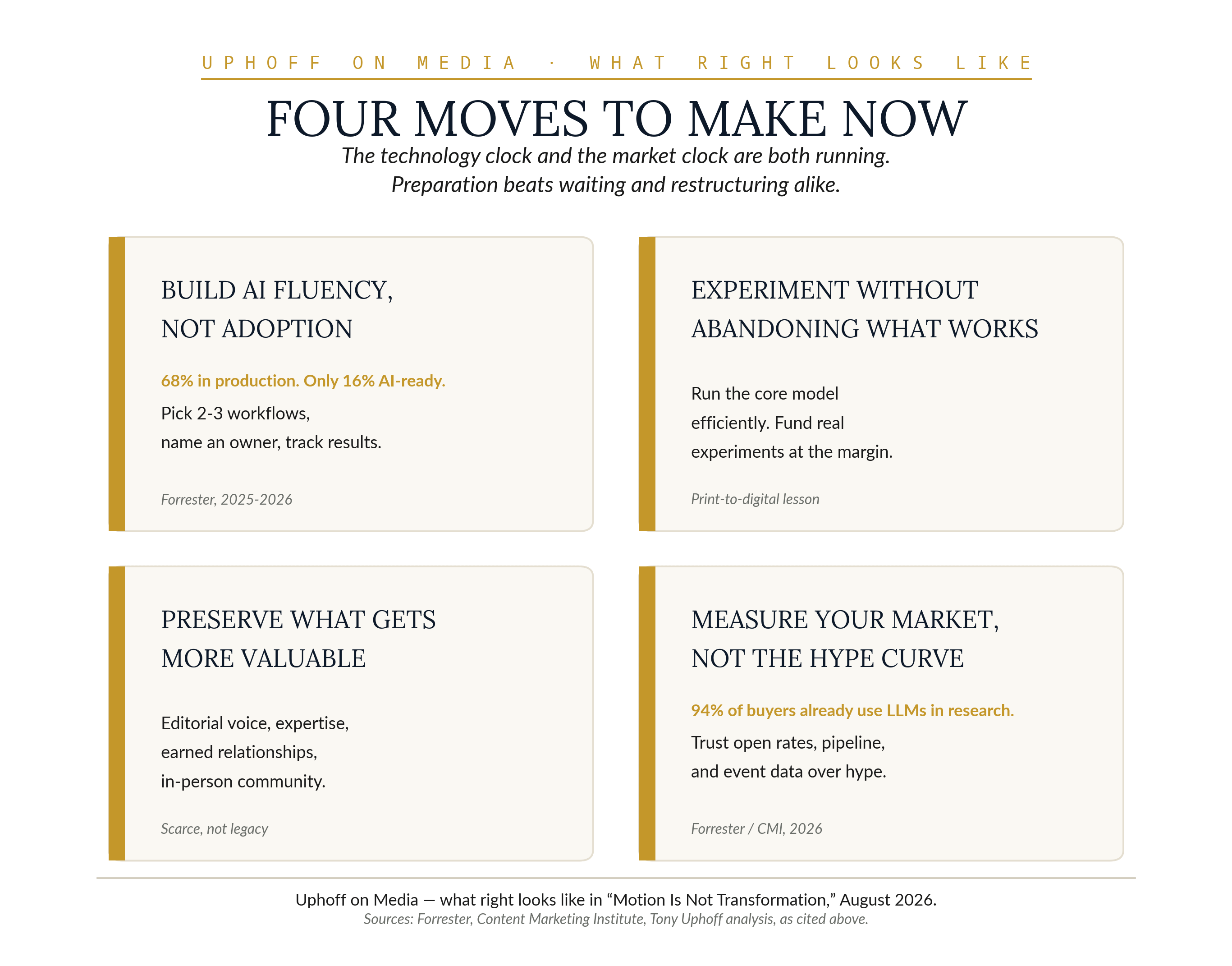
Build AI fluency, not just AI adoption. Fluency isn’t a login count or a completed training module. It’s employees demonstrating use that improves the quality and efficiency of a workflow, the same bar I’d apply to any other skill on a team. Sixty-eight percent of organizations already run generative AI in production, but only 16% of workers have high AI readiness by Forrester’s measure, and that gap is widening, not narrowing, because people afraid of the AI axe stop volunteering to get good at the tool. Make it concrete: pick two or three workflows where the win is measurable, name an owner for each, and track output quality and time-to-completion before and after, not usage logs. Build the competency deliberately or watch the Forrester rehire prediction happen to your own org chart.
Experiment with new models without abandoning proven ones. The print-to-digital playbook’s real lesson: the first wave rarely creates bigger profit pools. Run the existing revenue model as efficiently as you can while funding genuine experiments at the margin. Don’t burn the runway to look transformed.
Preserve the assets that get more valuable in an AI-saturated world. Editorial voice. Human judgement, taste and expertise. Earned audience relationships. In-person community. These are not legacy liabilities. In a market flooded with AI-generated content and AI-mediated buyer journeys, they’re the scarce commodity. The leaders who understand this will hold them. The ones who don’t will sell them at exactly the wrong moment, the way Klarna nearly did.
Measure what’s actually happening in your market, not what the hype curve says should be happening. Buyers have already moved: 94% use LLMs in research, two-thirds of the buying journey happens without you. Your own data, open rates, event attendance, pipeline conversion, content performance, will tell you where your market’s clock actually is. Don’t let someone else’s prediction replace your own observation.
The bottom line
Here’s where I’ll add my personal perspective. There’s so much coverage, analysis, and hand-waving about AI right now that it would be easy to assume it’s wildly overhyped. It isn’t.
In 35 years of having a ringside seat at every major and minor technology wave, I can tell you agentic AI will change everything: how we learn and educate, how products and services get built and delivered, how companies are organized, how business models work, and how careers are managed. It will eventually redefine “scale” entirely.
If this piece feels like it’s handing you two instructions at once, that’s because it is. You cannot sit this one out, no matter where you are in the org chart. Do what Daniel Kahneman described in Thinking, Fast and Slow, just applied to a market instead of a mind: fast and slow, at the same time, about different things. Move fast on staying current. Track the technology itself and how competitors in your industry are actually applying it, and watch for the AI-native competitor who shows up with no warning. Move slowly and carefully on commitment. Nothing gets restructured, cut, or shipped until it clears the bar this piece keeps returning to: does it improve the quality or efficiency of what someone actually gets, not just how fast you moved.
Build for what's coming. Manage what's here. Know the difference. I never said running both clocks at once was simple. I said it was the job.
The views expressed in Uphoff on Media are entirely my own. They don’t represent the opinions of any company I’ve led, any board I’ve sat on, or any investor who’s had the pleasure of debating strategy with me over the years. If something I write here sounds brilliant, I’ll take full credit. If it turns out to be wrong, I was clearly misquoted by myself.
”Uphoff on Media” is published by Tony Uphoff, Founder and Managing Partner of Uphoff Advisory, LLC, a strategic advisory practice for founders, CEOs, and investors in B2B information, marketing, and technology. The businesses that drive business.