



"It's not personal, it's just business" gets said most often at the exact moment it is least true. Across a table. To someone whose job, title, or plans just changed. Nobody has ever walked out of that conversation agreeing with it.
I've said some version of the opposite for close to thirty years: people who say it's not personal, it's just business are kidding themselves. Business is highly personal. And as a leader, you will need to make decisions that are in the best interest of the business and not in the best interest of someone on your team, sometimes someone you like, respect, and hired yourself.
Both halves of that are true at the same time. Most of the damage leaders do to their teams, and to themselves, comes from pretending one of them isn't.
Management comes with two loyalties and no instructions
In Be Careful What You Wish For, I wrote about the question I've been asked every few months for three decades: should I get into management? That piece was about whether you're built for the seat. This one is about what happens after you say yes, when you discover the job comes with two loyalties and no instructions for holding both.
The first loyalty is to the person in front of you. The one who stayed late during the carve-out, who covered for you when your kid was sick, who you actually enjoy having a beer with.
The second loyalty is to the enterprise. That word sounds cold until you remember what it actually is: the other two hundred people, their families, the customers who bet their own plans on you delivering, the investors who funded the payroll. Deciding for the business is almost never deciding for a spreadsheet. It's deciding for a larger group of people who aren't in the room.
That's the weight. Business isn’t impersonal. It’s personal in two directions at once.
“It’s just business” and “we’re a family” fail the same way
The first lie is the one leaders tell themselves: it's just business. It's anesthetic. It lets you make the call without feeling the cost, which is exactly why it fails. The person across the table feels the cost in full, and they can tell you've numbed yourself to it. What they remember isn't the decision. It's that you seemed not to mind.
The second lie is the one leaders tell their teams: we're a family. It feels generous when you say it at the all-hands. It is a promise you can't keep. Families don't restructure. Families don't run performance reviews. Families don't sell the division. Netflix saw this clearly enough to write the opposite into its culture memo: "It's why we model ourselves on a professional sports team, not a family." Families, the memo says, "are about unconditional love." Every leader who has said "family" and then had to lay someone off has watched a normal business decision land as a personal betrayal. The word made it one.
The two lies run in opposite directions, and they fail the same way. Each one makes the tension go away by pretending one loyalty doesn’t exist. The job is to carry both.
What I told the team when we ended BYTE’s print edition
In 1998 I was group president at CMP Media, running a division north of $300 million, when CMP bought McGraw-Hill's Information Technology and Communications Group and handed the acquired brands to me. The best known of them was BYTE, which had been the reference point for serious computing since its first issue in September 1975.
From diligence onward, two groups of people were watching every move. The CMP employees in my division wanted to know what the acquisition meant for their positions and their work. The people coming over from McGraw-Hill wanted something harder to give: assurances that their brands, and their jobs, were safe.
That's the moment the family lie is most tempting. A few warm promises at an integration meeting would have bought a quiet month. They also would have been promises nobody could keep. Several of the acquired brands were in decline and hadn't led their niches for a while. BYTE's circulation had slid from roughly 523,000 in 1996 to about 443,000 by the time of the deal, the New York Times reported at the time.
We worked through the details, and then we made the calls. BYTE suspended its print edition after the July 1998 issue and moved online. A second acquired brand closed outright, its circulation and other assets folded into another title. Both decisions cost people their jobs.
When we told the team, I said what I'd believed for a long time: "'This is business, not personal' really isn't accurate. Business is highly personal, and particularly so for the people who lost their jobs today. At times, as leaders, we need to make decisions that are in the best interest of our business and that may not be in the best interests of some of the people involved. This is one of those times."
It didn't make the news any easier to hear. Nothing would have. What it did was refuse both lies in the same breath: it didn't pretend the decision was painless, and it didn't pretend the decision was still open. BYTE's last print issue still gets written about as the end of an era in technology publishing. It was. It was also the right call for the business. Both of those were true on the same day, and a leader has to be able to say both.
Managers are carrying more of this, and doing it alone
The numbers say this matters more than most leaders admit. Gallup's research has held for a decade that managers account for at least 70 percent of the variance in employee engagement across business units. As far as the team is concerned, the manager is the job.
And managers are carrying it worse. Gallup's 2026 State of the Global Workplace report puts manager engagement at 22 percent in 2025, down from 31 percent in 2022, with five of those nine points lost in a single year. The same report found leaders feel more stress, more anger, more sadness, and more loneliness day to day than individual contributors, with loneliness running ten points higher.
The person with the most influence over how everyone else experiences work is increasingly the person most alone in it. That's what happens when leaders try to carry both loyalties without a system for doing it.
Give, Ration, Hold: three zones, three different rules
The advice leaders usually get here is to be friendly but not friends, approachable but with boundaries. It's not wrong. It's just not usable, because it treats warmth and authority as one dial where turning up one turns down the other.
They're not one dial. What a leader offers the team falls into three different zones, and each one runs by its own rule.
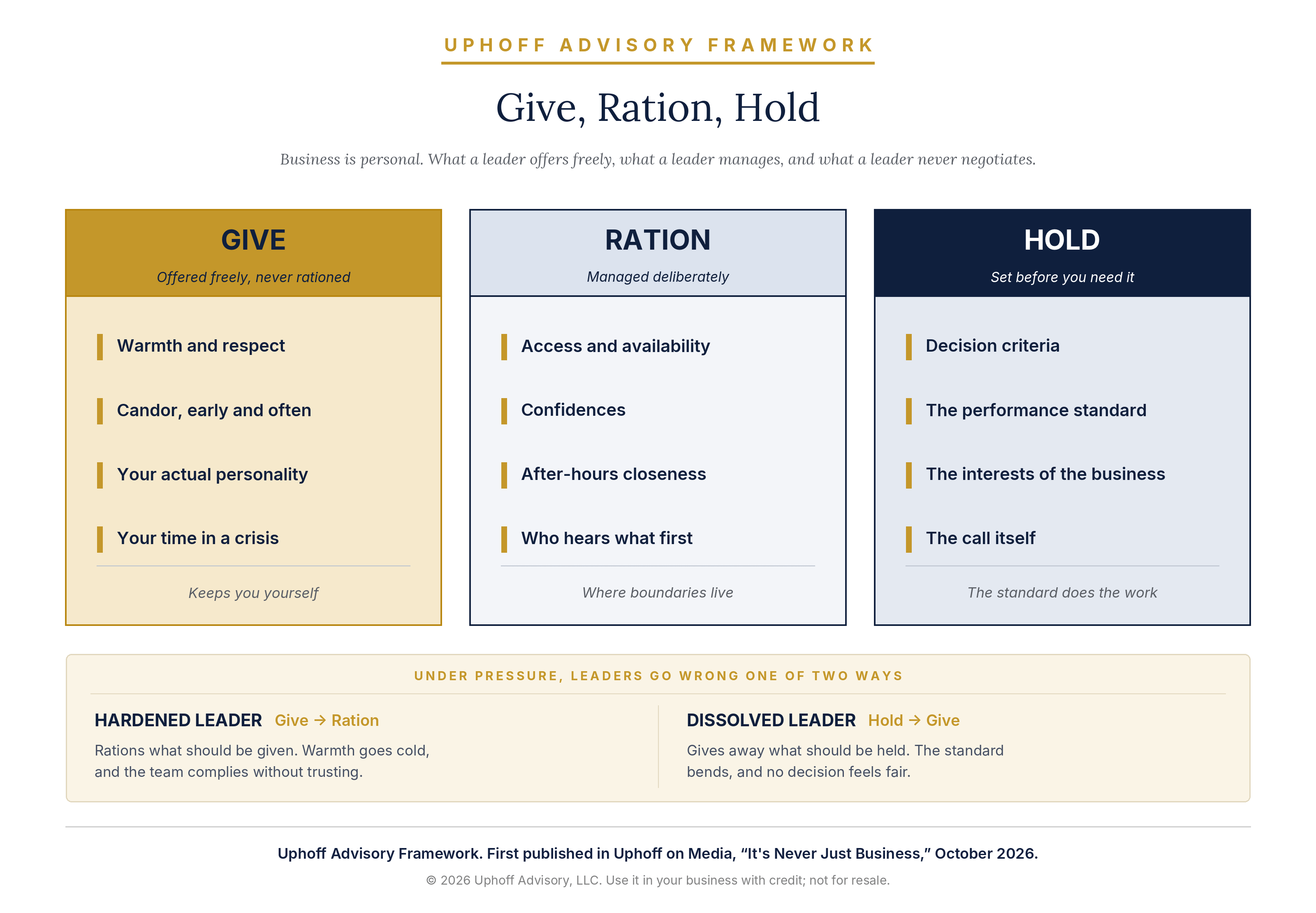
Here is an Uphoff Advisory Framework you can download and use in your business. Use it to check which way you lean when the pressure is on.
View the full Uphoff Advisory Framework library →
How each zone works
Give freely. Warmth, respect, candor, your actual personality, your time when someone's world is on fire. These never get rationed, not even during a layoff, especially not then. This is the zone that keeps you yourself. The leader who goes cold to protect themselves hasn't gotten tougher. They've gotten worse at the job, because people stop telling a cold leader the truth.
Ration. Access, confidences, after-hours closeness, who hears what first, which friendships deepen and how visibly. This is where boundaries actually live. Warmth stays constant; intimacy is managed. You can be the same person with everyone and still not be equally close to everyone, and on a team, uneven closeness reads as favoritism long before anyone says so.
Hold. The decision criteria, the performance standard, the interests of the business. These get set before you need them and stay put when you do. When a hard call comes, it should read to the team as a standard being applied, not a friendship being broken. The standard does the work so the relationship doesn't have to absorb it.
The two most common failures are mirror images. The hardened leader rations what should be given, goes guarded and formal, and ends up with a team that complies without trusting. The dissolved leader gives away what should be held, bends the standard for the people they like, and ends up with a team that trusts them personally and doesn't believe any decision is fair. Most leaders lean toward one or the other under pressure. Knowing which way you lean is half the work.
The decision is business. The delivery is personal
The simplest operating rule I know: make the decision on business terms, and deliver it like a human being.
The business decision answers whether: Does this role still exist? Is this person meeting the bar? Does the plan still work? That decision should be clear-eyed, consistent, and written down before any name is attached to it.
The delivery answers how. Who tells them, and whether it’s you. How much notice. What you say, and whether you say it yourself instead of reading it off an HR script. What support comes with it: severance you fought for, a reference you’ll actually give, a call you’ll take six months later. Nothing about the delivery changes the decision. Everything about it changes what the decision means to the person living through it, and to the forty people watching how you handled it.
Two more rules sit underneath that one.
Early truth is the kind version. The cruelest thing a leader can do is protect a relationship by withholding bad news about performance. The feedback you skip in March to keep things friendly becomes the termination in October that nobody saw coming. Candor delivered early is warmth. Candor delivered late is an ambush.
Don't need your team to like you. Wanting to be liked is fine. Needing it is where every boundary breaks. A leader whose only source of support is the team will ration the wrong things and give away the wrong things, because the team has become the thing they can't afford to lose. The support system I called the hardest trait in Be Careful What You Wish For, the peers, the board member you can call, the coach, the family that knows you outside the title, is what lets you be warm with your team without needing anything back from them.
AI will make the analysis sharper. The delivery still has to be yours
There's a 2026 version of the first lie, and it's already here. Employers cited AI in 120,136 announced job cuts in the first nine months of this year, according to Challenger, Gray & Christmas, more than double the 54,836 for all of 2025. As agentic AI takes on more of the analysis behind staffing, territory, and performance decisions, leaders will be tempted to hand the moral weight to the system along with the math. The model ranked the roles. The model flagged the underperformers. It's not personal, it's just the output.
It’s the same anesthetic, and it will fail the same way. Machines can sharpen the decision. They can make the criteria more consistent and the data harder to argue with. That’s useful. They can’t carry the delivery, and a team will not accept a decision delivered by someone hiding behind a dashboard. The more of the analysis agents take on, the more of the leader's job is exactly this part: owning the call and delivering it like a human being.
What your team remembers is how you delivered it
Leadership doesn't ask you to resolve the tension between the person in front of you and the people counting on the enterprise. It asks you to carry it, openly, without numbing yourself to one side or lying to the other.
Give the warmth away every day. Ration the closeness. Hold the standard before you need it. Then, when the hard call comes, and it will, make the decision on business terms and deliver it like a human being.
It was never just business. It was always yours to decide.
Keep going: Be Careful What You Wish For and The Miss Isn't the Failure. What You Do Next Is
The views expressed in Uphoff on Media are entirely my own. They don't represent the opinions of any company I've led, any board I've sat on, or any investor who's had the pleasure of debating strategy with me over the years. If something I write here sounds brilliant, I'll take full credit. If it turns out to be wrong, I was clearly misquoted by myself.
"Uphoff on Media" is published by Tony Uphoff, Founder and Managing Partner of Uphoff Advisory: a strategic advisory practice for founders, CEOs, and investors in B2B information, marketing, and technology. The businesses that drive business.